



About Kanji Blocks
Learn real Japanese: trace radicals, build kanji, and pass the master exam across 20 lessons.
About this game
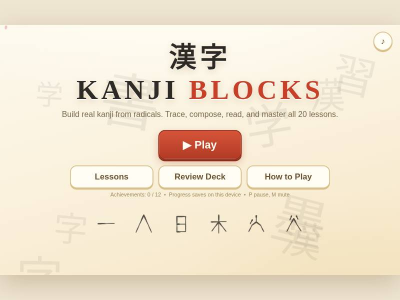
Kanji Blocks teaches you real Japanese the way students in Japan actually learn it, across 20 lessons that start with a single stroke and end with a no guide master exam. Lessons 1 to 5 drill 12 basic radicals with an animated brush guide that shows stroke order and direction: start at the glowing dot, follow the arrow, and ink splashes when your hand is steady. From lesson 6 you compose kanji from radical tiles, learning the true structure of each character: 休 is a person 人 leaning on a tree 木, which is why it means rest; 明 joins sun 日 and moon 月, the two great lights, which is why it means bright. Every build ends with the character's etymology story. Lessons 11 and 12 train your eye on lookalike twins like 土 earth versus 士 gentleman, then a 90 second sprint recall tests your hand. Lessons 15 to 17 build real compounds such as 日本 (Japan), 火山 (volcano) and 休日 (holiday) and drill onyomi versus kunyomi readings, lesson 18 drops the characters into real Japanese sentences, lesson 19 is a 12 round gauntlet with 3 hearts, and lesson 20 is the master exam: five kanji, no guides, 70 points to pass. A spaced repetition review deck keeps every radical and kanji you unlock on a smart schedule, with ink brush rendering, splash particles, drifting petals, and fully synthesized brush and chime sounds, plus a mute control. Twelve achievements, three stars per lesson, and all progress saves privately in your browser. No account required and no ads interrupt your game.
- Controls
- Mouse or touch: draw strokes on the canvas, tap radical tiles then glowing slots; P or Esc pause, M mute
- Supported devices
- Desktop, phone, tablet
- Developer
- Plyarc
- Genre
- Puzzle
- Latest update
- October 2026
- Rating
How to play
- 1
Press PLAY. Lessons 1 to 5 are radical school: start at the glowing dot and trace each stroke in the arrow's direction.
- 2
From lesson 6, tap a radical tile, then tap a glowing slot to build the kanji. Order matters: the pieces only fit one way.
- 3
Answer reading rounds: ON readings come from Chinese, KUN readings are native Japanese. Lessons 11 and 12 drill lookalike twins.
- 4
Lessons 13 to 17 add a 90 second sprint recall, real compounds like 日本, and a 10 round reading gauntlet. Lesson 18 uses real sentences.
- 5
Clear the 3 heart review gauntlet, then pass the lesson 20 master exam with no guides at 70 points to earn Kanji Master.
Controls
Click and drag on the canvas to trace strokes. Click a radical tile, then click a glowing slot to place it. P or Esc pauses, M mutes.
Draw strokes with your finger, starting at the glowing dot. Tap tiles and slots to build kanji. All buttons are sized for thumbs.
Tips & tricks
Stroke order has rules: top to bottom, left to right, horizontals before verticals. The guide arrow always shows the correct direction.
Learn radicals as pictures: 日 is the sun, 木 is a tree, 人 is a person. Kanji stop being random lines once you see the parts.
In the review deck, mark Again honestly. Cards you miss come back sooner, and that is exactly how spaced repetition locks them in.
On Sprint Recall, write fast but stay above 55 points per kanji. A careful pass beats a rushed retry against the clock.
FAQ
How do you play Kanji Blocks?
Choose a lesson and trace each stroke in the correct order with the animated brush guide, tap radical tiles into slots to build kanji, pick the right onyomi or kunyomi reading, and clear timed recall and sentence rounds. 20 lessons take you from your first stroke to the no guide master exam.
Is Kanji Blocks free on Plyarc?
Yes, Kanji Blocks is completely free with no downloads, no account, and no ads during gameplay. Unlocked lessons, stars, achievements, best scores, and your spaced repetition review deck save privately in your browser.
Will Kanji Blocks teach me real Japanese?
Yes. Every character uses real stroke order, real radicals, and real readings: 休 is read kyuu or yasumu and means rest, 日本 reads nihon and means Japan. The review deck uses spaced repetition, the same technique behind serious flashcard apps.